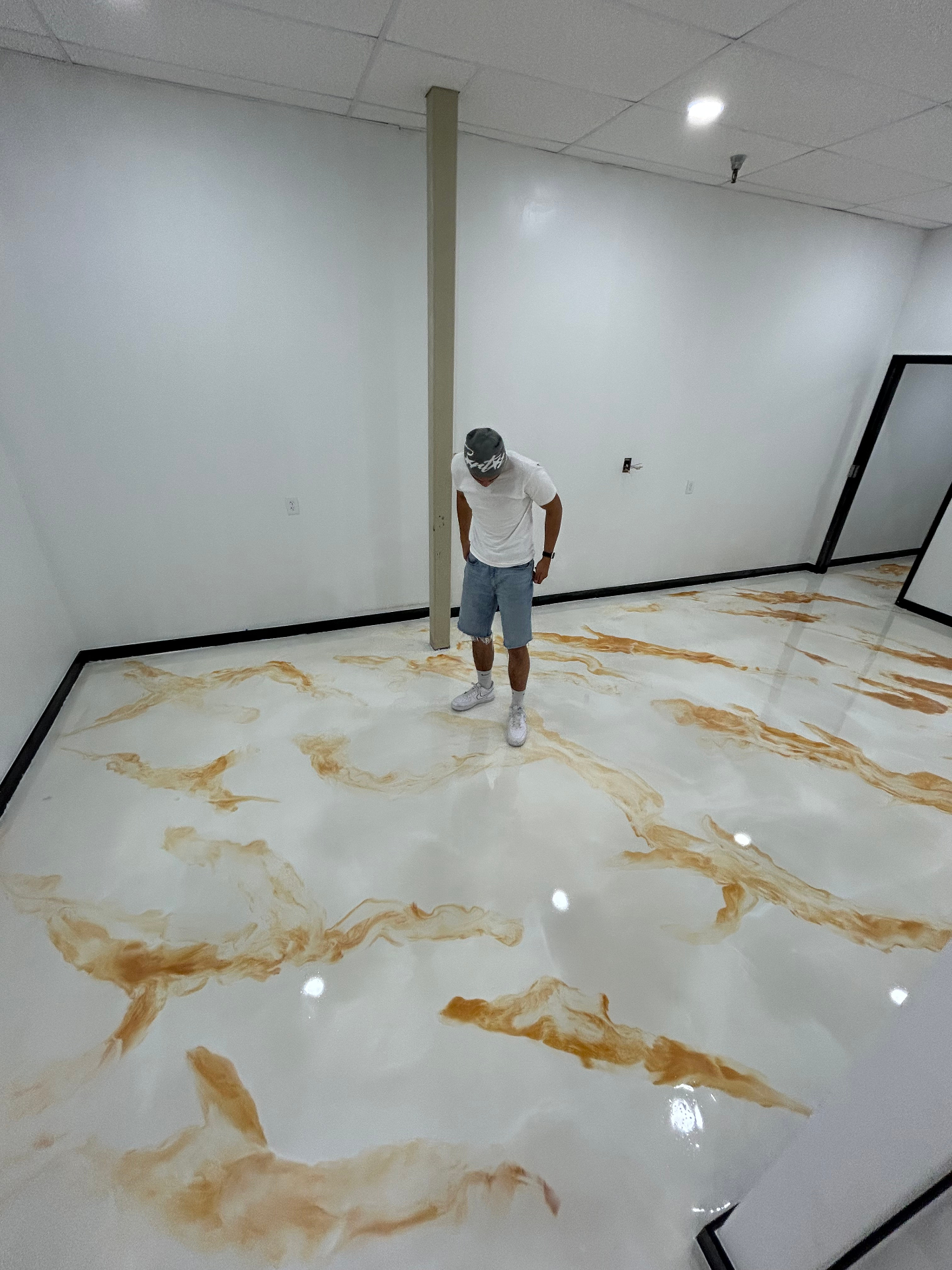
Diamond-ground, forklift-rated polyaspartic and urethane cement systems engineered for warehouses, manufacturing, restaurants, retail, medical, schools, and aircraft hangars — installed across Arkansas, Missouri, and Oklahoma with zero disruption to your operation.
The commercial floor system that keeps your business running.
Your floor is the single most-abused surface in your building. Forklifts, pallet jacks, foot traffic, dropped tools, spilled chemicals, thermal shock, moisture from the slab, and the constant grinding of daily operations — bare concrete simply cannot survive it. Neither can hardware-store epoxy paint. Every year, businesses across Arkansas, Missouri, and Oklahoma pour tens of thousands of dollars into "budget" coatings that peel, powder, or delaminate within twelve months, forcing another shutdown and another install.
Imperial Epoxy Flooring installs the commercial coating systems that professional facility managers actually specify. Diamond-ground substrate, moisture-tested slab, 100%-solids epoxy primer, high-build body coat, and a UV-stable polyaspartic or industrial urethane cement wear layer engineered to your traffic pattern, chemical exposure, and downtime tolerance. Whether you run a 3,000 sq ft restaurant kitchen in Fayetteville, a 50,000 sq ft distribution center in Springdale, an auto dealership in Rogers, a brewery in Bentonville, a manufacturing plant in Fort Smith, a medical clinic in Little Rock, or a private aircraft hangar in Joplin — we build the floor to the job.
This page is the practical, no-fluff guide to how commercial epoxy flooring actually works: prep, primer, resin selection, safety striping, chemical resistance, forklift ratings, decorative options, cure times, warranties, and the honest reasons floors fail. If you're comparing commercial bids across the four-state region, read this before you sign anything.
Industries We Serve
Ten industries. One professional floor system.
Every project is spec'd to its environment — traffic pattern, chemical exposure, aesthetic requirement, and downtime tolerance. This is where we work.
Warehouses & Distribution
Forklift-rated polyaspartic systems with OSHA aisle striping, dock leveler zones, and rack-line delineation. Handles 24/7 operations across 5,000–200,000+ sq ft facilities.
Manufacturing & Industrial
High-build epoxy and urethane cement systems built for CNC lines, presses, hydraulic oil, thermal shock, and constant abrasion. Zone-scheduled installs keep production moving.
Restaurants & Breweries
USDA/FDA-compliant urethane cement kitchens with integral cove base, non-slip texture, and decorative flake or quartz for front-of-house — from craft breweries to full-service restaurants.
Retail & Showrooms
Metallic epoxy, decorative flake, and polished concrete finishes that hold up to thousands of foot traffic per day while doubling as a design statement.
Automotive & Dealerships
Hot-tire-resistant polyaspartic for service bays, dealership showrooms, quick-lubes, tire shops, transmission shops, and body shops. Chemical-proof and easy to clean.
Office Buildings
Low-VOC decorative systems and polished concrete for lobbies, corridors, and open-plan offices — installed after hours to eliminate business disruption.
Churches & Fellowship Halls
Decorative flake and stained polished concrete for sanctuaries, fellowship halls, gymnasiums, and kitchen ministries. Beautiful, durable, and easy for volunteer cleaning crews to maintain.
Medical, Dental & Veterinary
Sanitary, seamless coatings for clinics, hospitals, dental offices, imaging suites, veterinary hospitals, and surgical prep areas. Bacteria-resistant, integrally coved, easy to disinfect.
Schools & Athletic Facilities
Slip-resistant, decorative coatings for locker rooms, weight rooms, cafeterias, gymnasiums, art rooms, and shop classes. Installed on summer schedules to hit fall reopening.
Aircraft Hangars
Jet-fuel- and hydraulic-fluid-resistant polyaspartic systems for private, corporate, and military hangars. Static-dissipative and anti-slip options available.
The Commercial System
The seven layers of a commercial floor built to last decades.
A commercial coating is only as strong as the layer beneath it. Skip prep, skip moisture testing, or substitute a cheaper resin at any stage and the entire system fails. Here is exactly what we install.
01
Diamond-Ground Concrete Preparation
Industrial planetary grinders with HEPA vacuum extraction open the slab to a CSP-2 to CSP-3 profile — the ICRI-recommended surface for professional coatings. Old paint, sealers, glue, oil, and laitance are removed in one pass. Zero acid, minimal dust, and a mechanically ready substrate.
02
Moisture Testing & Mitigation
Suspect slabs are calcium-chloride and RH tested. If the slab exceeds coating manufacturer limits, we install a moisture-mitigating 100%-solids epoxy primer that blocks vapor transmission and prevents the delamination, bubbling, and blushing that ruin unmitigated commercial floors.
03
Structural Crack & Joint Repair
Every crack, spall, and control joint is chased with a crack saw, cleaned, and filled with structural polyurea or semi-rigid joint filler. Damaged edges are rebuilt. The slab is restored to a monolithic, coating-ready surface.
04
100%-Solids Epoxy Primer / Base Coat
A high-build epoxy primer is squeegeed and back-rolled into the ground profile — the mechanical and chemical anchor that everything above depends on. This layer is why properly prepped floors do not peel.
05
Body Coat: Broadcast Flake or Quartz (Optional)
For decorative, high-traction, or sanitary environments we broadcast vinyl flake or graded quartz aggregate into the wet epoxy body coat, then scrape and vacuum the surface flat before the topcoat. Structural body coats also add mil-thickness and impact resistance.
06
UV-Stable Polyaspartic or Urethane Cement Topcoat
The wear layer is chosen for your environment: polyaspartic for warehouses, retail, auto, and offices (fast cure, UV-stable, chemical-resistant); urethane cement for food, brewery, and heavy industrial (thermal-shock-proof, USDA-compliant, ultra-durable).
07
Safety Striping, Aisle Marking & Line Detail
OSHA color-coded aisles, hazard hatching, fire lanes, equipment footprints, forklift lanes, and custom logos are installed with the same polyaspartic resin as the field — permanently bonded, not painted on top.
We visit your facility, take moisture readings, evaluate slab condition, discuss chemical exposure, forklift patterns, downtime windows, and design goals. Written spec-and-price package delivered in 48–72 hours.
Step 2
Scheduling & Phasing
For active facilities we phase the work — nights, weekends, or zoned sections — so production, retail, or service continues uninterrupted.
Step 3
Prep & Diamond Grind
Everything protected and masked. HEPA-vacuumed planetary grinders open the slab. Old coatings, oil, and laitance removed. Cracks and joints repaired.
Step 4
Prime & Body Coat
Moisture-mitigating primer where required, followed by 100%-solids epoxy primer and any broadcast body coat spec'd for your environment.
Step 5
Polyaspartic Topcoat
UV-stable, chemical-resistant polyaspartic (or urethane cement) applied at engineered mil thickness. Anti-slip aggregate broadcast where required.
Step 6
Striping & Line Detail
OSHA aisle markers, fire lanes, forklift lanes, hazard hatching, equipment footprints, and custom graphics installed with matching resin.
Step 7
Handoff & Cure
Foot traffic in 4–12 hours. Forklift-ready in 24–48 hours. Full punch walk, warranty documentation, and maintenance guide delivered.
Preparation Determines Lifespan
Diamond grinding, moisture mitigation, and crack repair — the three things cheap contractors skip.
Nearly every commercial coating failure across Arkansas, Missouri, and Oklahoma traces back to one of three shortcuts: bad prep, ignored moisture, or unrepaired cracks. We eliminate all three on every project.
Our Commercial Prep
Diamond Grinding + Moisture Mitigation
Industrial planetary grinders open concrete to CSP-2/3
HEPA vacuum extraction — dust-controlled installs
Old coatings, paint, glue, and laitance removed
Calcium-chloride and RH moisture testing
Vapor-barrier primer installed where required
All cracks, spalls, and joints structurally repaired
Consistent, coating-ready profile across entire slab
What Cheap Bidders Do
Acid Etch + Skip Moisture
Acid etch only lightly opens surface — CSP-1 at best
Cannot remove existing coatings, paint, or oil
Salt residue prevents adhesion
No moisture testing — coatings bubble and blush
Cracks painted over — reappear within months
Inconsistent profile — spot failures within a year
The #1 reason commercial floors fail in 12 months
Real-World Performance
Built for forklifts, chemicals, heat, and 24/7 operations.
Forklift & Pallet-Jack Traffic
Polyaspartic and high-build epoxy topcoats are engineered for constant forklift, pallet-jack, and scissor-lift traffic. Steel-wheeled pallet jacks — the toughest test in any warehouse — leave no mark on a properly spec'd Imperial floor.
Heavy Machinery & Point Loads
For CNC lines, presses, hydraulic equipment, and rack systems we install high-build epoxy or urethane cement bodies up to 1/4-inch thick — engineered to absorb impact, resist thermal shock, and outperform bare concrete under any static load.
Chemical Resistance
Motor oil, hydraulic fluid, brake fluid, gasoline, diesel, antifreeze, battery acid, food acids, brine, most cleaning chemicals, and jet fuel — all resisted. Novolac topcoats available for aggressive solvent, plating, and wastewater exposure.
Hot-Tire & Thermal Shock
Polyaspartic resists hot-tire pickup from vehicles pulling in off summer asphalt. Urethane cement handles thermal shock from steam cleaning, boil-over spills, and cold-storage transitions in food and brewery environments.
Waterproof & Moisture-Sealed
Fully waterproof cured surface. Slab moisture managed with vapor-barrier primer during install. Food-service and brewery floors include integral cove base for full sanitation.
Effortless Maintenance
Sweep or auto-scrub with warm water and pH-neutral cleaner. No wax, no re-sealing. Auto-scrubbers, ride-on scrubbers, and pressure washers are all safe on a properly installed system.
OSHA Safety Striping
Permanent color-coded striping that outlasts painted lines.
Painted aisle stripes chip, peel, and fade within months of forklift traffic. Our safety striping is installed with the same polyaspartic resin as the field — mechanically bonded to the primer, embedded into the coating system, and permanently color-fast. Meets OSHA 1910.144 color-code guidance and ANSI Z535.
We install aisle markers, fire lanes, equipment footprints, forklift lanes, pedestrian crossings, dock zones, hazard hatching, warehouse pick-slot numbers, and custom logos or branding as part of the same install — with clean, taped lines and no bleed-through.
OSHA Color-Code Legend
Yellow — Aisle & Walkway Boundaries
Red — Fire Lanes & Emergency Equipment
Orange — Energized Equipment Hazards
Green — First Aid & Safety Equipment
Blue — Informational / Storage
Black & Yellow Hatching — Restricted Zones
Decorative Finishes
Commercial durability. Retail-grade aesthetics.
Commercial floors don't have to look industrial. Every decorative system we install carries the same polyaspartic performance layer as our warehouse floors — so your showroom, restaurant, or lobby is as tough as it is beautiful.
Full Flake Broadcast
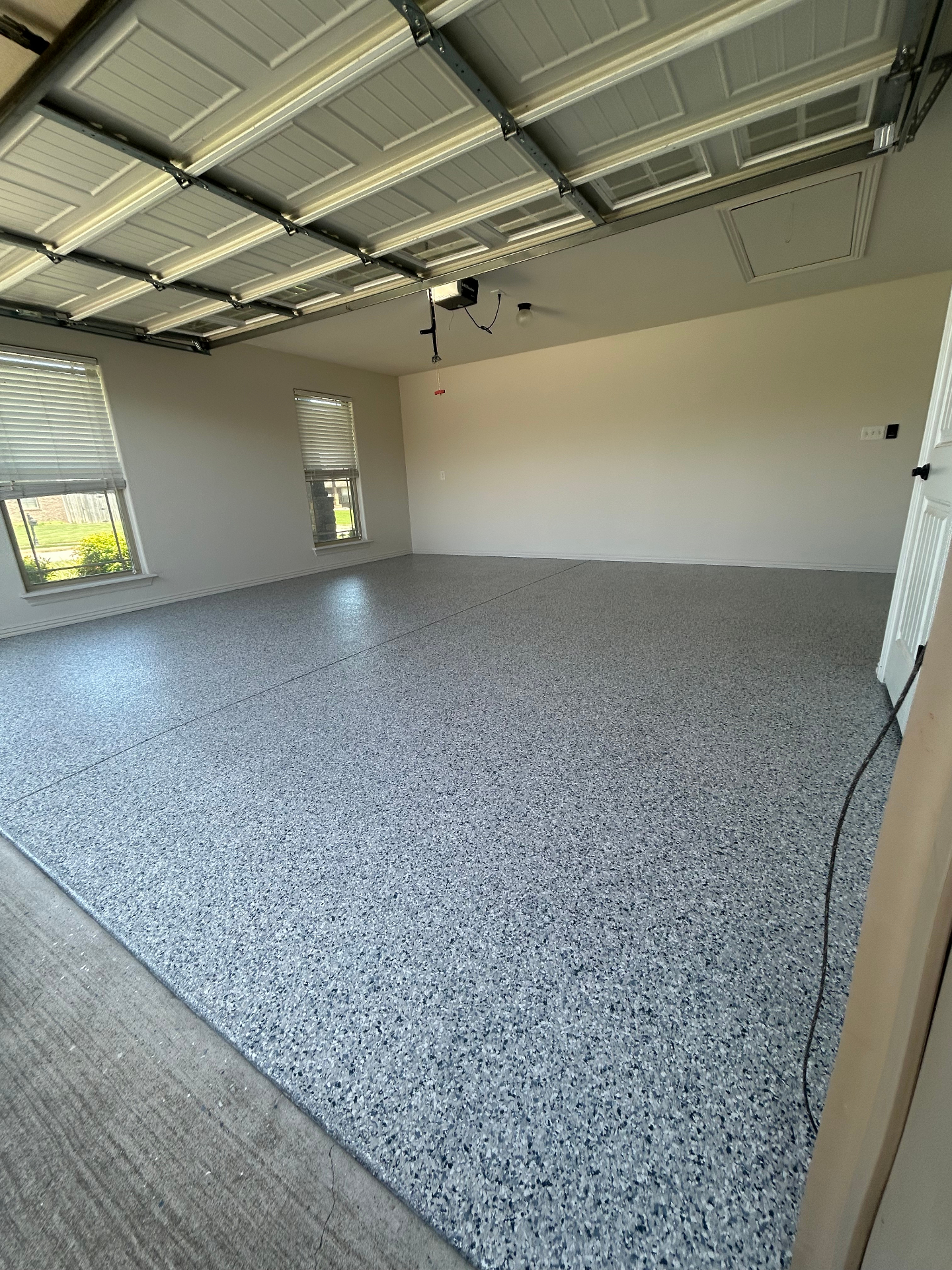
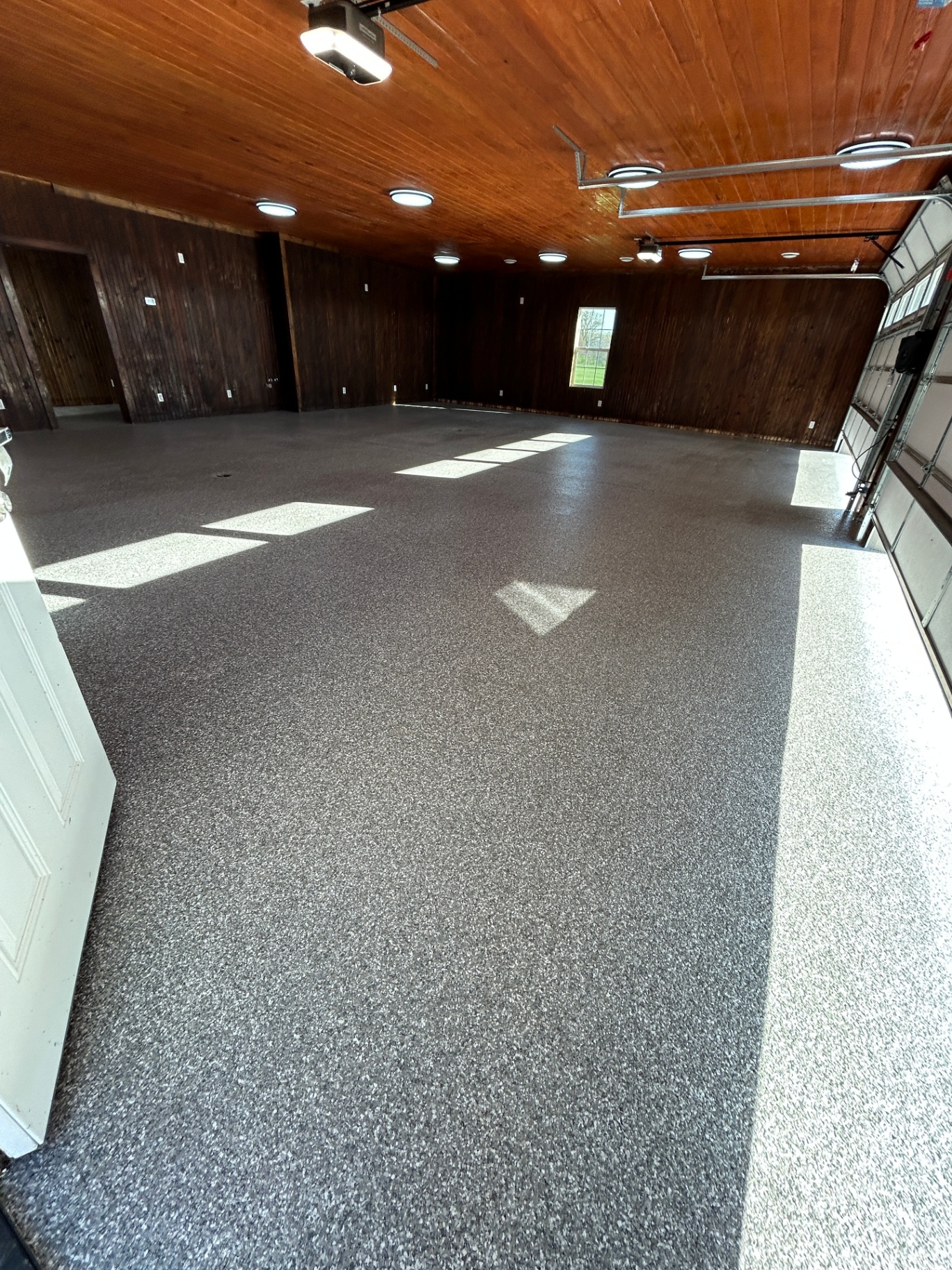
Dozens of color blends broadcast to full rejection. The workhorse decorative system for restaurants, auto shops, breweries, retail, and commercial garages.
Metallic Epoxy
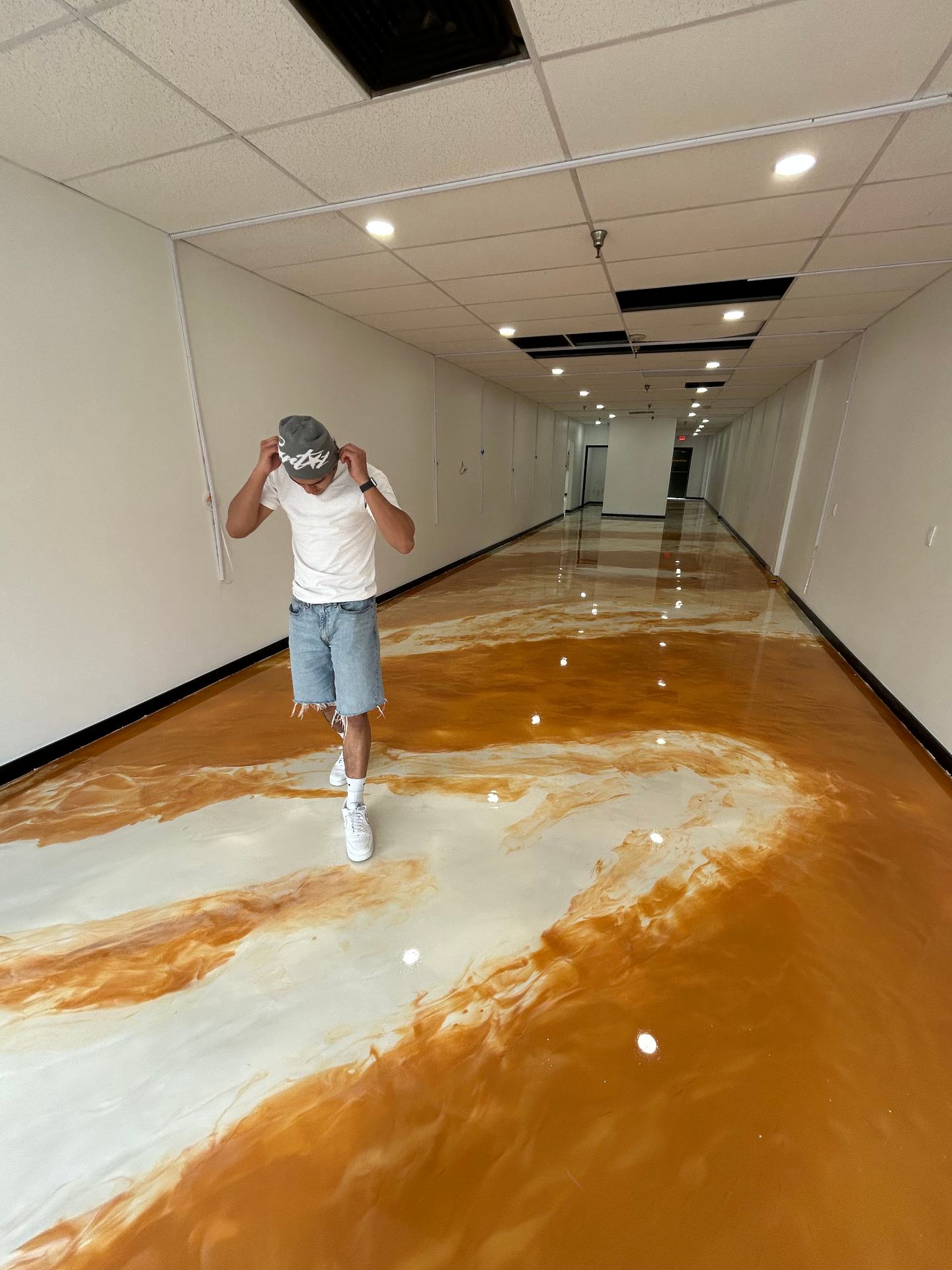
3D metallic pigments create one-of-one showpiece floors for dealerships, retail showrooms, corporate lobbies, and hospitality.
Quartz Broadcast
Graded colored quartz aggregate for heavy-duty decorative floors in kitchens, medical, veterinary, and pharmaceutical spaces.
Stained & Polished Concrete
Industrial polished-concrete look with dye or stain accents — sealed and dust-proofed for warehouses, retail, and modern office space.
Case Studies
Real commercial installs. Real four-state region.
22,000 sq ft Distribution Warehouse — Springdale, AR
System Spec
Diamond grind · moisture-mitigation primer · high-build epoxy body · polyaspartic topcoat · full OSHA aisle striping
Result
Installed over three consecutive weekends without shutting down operations. Two years in: no delamination, no forklift wear on aisle lines, no tire pickup.
Auto Dealership Service Bays — Rogers, AR
System Spec
Diamond grind · crack chase · epoxy primer · full flake broadcast · anti-slip polyaspartic topcoat
Result
Twelve service bays coated in a single weekend. Chemical spills wipe up in seconds. Techs report the shop is unrecognizable — and easier to clean.
Craft Brewery Production Floor — Fayetteville, AR
System Spec
Diamond grind · urethane cement body · integral cove base · anti-slip topcoat · sanitary color-coded zones
Result
USDA-compliant, thermal-shock-proof floor for boil-overs and constant washdown. Passed brewery insurance inspection first pass.
Corporate Retail Showroom — Bentonville, AR
System Spec
Diamond grind · epoxy primer · metallic epoxy body · high-gloss polyaspartic topcoat
Result
Feature floor that doubles as a design element. Two years of daily foot traffic with zero wear-through and easy nightly auto-scrub maintenance.
"Imperial phased our 22,000 sq ft warehouse install over three weekends without shutting us down for a single shift. Two years in, the aisle striping still looks like the day it went down. Best commercial contractor we've hired."
"We needed a USDA-compliant urethane cement floor with integral cove base — installed around production. Imperial spec'd it perfectly, worked nights, and we passed insurance inspection first pass. Zero downtime."
"Twelve service bays coated in a weekend. Techs said it was the cleanest install they'd ever seen — dust-controlled, no fumes lingering, and drivable Monday morning. The floor still looks new."
Maintenance, Lifespan & Warranty
Decades of floor. Minutes of maintenance.
Maintenance is intentionally simple. Sweep, dust mop, or blower for dry debris. Auto-scrub, ride-on scrubber, or mop with warm water and a pH-neutral cleaner for anything sticky. Pressure wash safely at appropriate PSI. No wax, no sealer, no annual re-coating. For heavy industrial floors, a monthly ride-on scrub with a soft brush keeps the surface performing for 15+ years.
Expected lifespan for a properly diamond-ground, primed, and polyaspartic-topcoated commercial floor is 15–25+ years in warehouse, retail, auto, and office environments. Heavy industrial urethane cement systems perform 20–30+ years in food, brewery, and manufacturing environments. Nearly every early failure in the industry traces back to skipped prep — not to the coating itself.
Commercial warranty. Every commercial installation is delivered with a written craftsmanship and adhesion warranty. Term length is matched to system spec — standard warehouse and retail polyaspartic systems carry a multi-year adhesion warranty; industrial urethane cement and heavy-duty systems carry longer commercial warranties. Because we grind, moisture-test, prime, and topcoat properly, warranty claims are extraordinarily rare.
Serving The Four-State Region
Commercial floors installed across Arkansas, Missouri & Oklahoma.
Headquartered in Northwest Arkansas. Commercial and industrial installs traveled throughout Arkansas, Missouri, Oklahoma, and Kansas.
We'll visit your facility, take moisture readings, evaluate your slab and traffic pattern, discuss your downtime tolerance, and deliver a written spec-and-price package — typically within 48–72 hours.
What industries do you install commercial epoxy flooring for?
Imperial Epoxy Flooring installs commercial and industrial coating systems for warehouses, manufacturing plants, restaurants, retail stores, automotive shops, dealerships, office buildings, churches, medical facilities, dental clinics, veterinary practices, schools, gymnasiums, breweries, aircraft hangars, and food-processing facilities throughout Arkansas, Missouri, Oklahoma, and the Northwest Arkansas region.
How much does commercial epoxy flooring cost per square foot?
Commercial epoxy pricing typically ranges from $4–$12 per square foot depending on system thickness, prep condition, moisture mitigation, chemical resistance requirements, decorative finish, and safety striping. Standard warehouse polyaspartic systems run $4–$7/sq ft; heavy-duty industrial urethane cement systems for food and beverage plants run $9–$15/sq ft. Every commercial quote is free, on-site, and delivered in writing.
Do you handle large warehouse and manufacturing floors?
Yes. We routinely install 10,000 to 100,000+ sq ft commercial and industrial floors across Arkansas, Missouri, and Oklahoma. Our crews scale with the project — multiple industrial planetary grinders, ride-on scrapers, HEPA dust extraction, and phased scheduling that keeps your facility operating.
How is diamond grinding done on a commercial or industrial floor?
We use industrial planetary grinders with diamond tooling matched to your slab hardness, paired with HEPA-filtered vacuum extraction so there is virtually no airborne dust. Grinding opens the concrete to a CSP-2 to CSP-3 profile — the surface profile required for a professional coating to mechanically bond and last.
Why is diamond grinding better than acid etching or shot blasting for commercial work?
Diamond grinding is the ICRI-recommended prep for polyaspartic and epoxy systems. It removes old coatings, oil, and laitance in one pass, is dust-controlled, produces a consistent profile, and does not leave the residues that acid etching does. Shot blasting is acceptable for very large open floors, and we combine both when a project warrants it — but we never rely on acid etching.
Can you install epoxy flooring over an existing coating?
Almost never as-is. Existing coatings are mechanically removed during grinding because a new coating is only as strong as what it bonds to. Removing failed coatings is included in our commercial quote.
Do you handle concrete crack repair and joint filling?
Yes. Every crack, control joint, cove, and spall is chased, cleaned, and filled with structural polyurea or semi-rigid joint filler prior to priming. This restores the slab to a monolithic surface and prevents future coating failure at joints.
How do you handle moisture in a slab?
We perform calcium chloride and RH moisture testing on any slab we suspect is out of tolerance. If the slab exceeds coating manufacturer limits, we install a 100%-solids epoxy moisture-mitigation primer that blocks vapor transmission before the primary coating goes down. This is the difference between a floor that lasts 15 years and one that bubbles in 6 months.
Can epoxy handle forklift and pallet-jack traffic?
Yes. Our commercial polyaspartic and industrial epoxy systems are engineered for heavy forklift traffic, steel-wheeled pallet jacks, scissor lifts, and constant abrasion. System thickness and topcoat spec are matched to your traffic pattern during the estimate.
What about heavy machinery, presses, and CNC equipment?
For manufacturing environments with static loads, hot machinery, or dropped tooling, we install thicker high-build epoxy or urethane cement systems (up to 1/4") that absorb impact, resist thermal shock, and outperform bare concrete under any point load rating you can throw at them.
Is commercial epoxy chemical-resistant?
Yes. Our systems resist oils, hydraulic fluid, brake fluid, gasoline, diesel, antifreeze, battery acid, most cleaning chemicals, brine, and food-grade acids. For extreme chemical exposure (plating, wastewater, aggressive solvents) we specify a novolac or urethane cement topcoat matched to your MSDS list.
How long does a commercial installation take?
A 5,000 sq ft warehouse can be prepped, primed, and topcoated in 2–4 days with polyaspartic. 20,000+ sq ft phased installs run 1–3 weeks, typically scheduled at night, on weekends, or in sections to keep you operating.
Do we have to shut down our facility?
Rarely. We routinely work nights, weekends, or in sectioned zones so production, retail, or restaurant operations continue. Polyaspartic cures fast enough that a section coated Friday night is drivable Sunday morning.
How fast does the floor cure?
Polyaspartic systems are foot-traffic-ready in 4–12 hours and rated for forklift traffic in 24–48 hours. Traditional epoxy systems need 24 hours foot / 72 hours full load. We choose the resin system to match your downtime tolerance.
Is it slippery? What about OSHA slip resistance?
We add a graded anti-slip aggregate to the topcoat matched to your environment — light aluminum oxide for retail and offices, medium silica for shops and warehouses, aggressive polymer grit for food and wet-process areas. All finishes can be spec'd to meet or exceed OSHA / ADA static coefficient of friction standards.
Can you install safety striping, aisle marking, and OSHA color coding?
Yes. Yellow aisle markers, red fire-lane striping, hazard hatching, walkway boundaries, forklift lanes, equipment footprints, and custom logos or numbering are all installed with the same polyaspartic resin as the main floor — they will not chip, peel, or wear off like painted stripes do.
Do you offer decorative options for restaurants and retail?
Yes. Full flake blends, quartz broadcasts, metallic epoxy, stained and polished concrete, and custom color blocking are all available for customer-facing commercial spaces. We regularly install decorative systems in restaurants, breweries, showrooms, boutiques, and offices.
Is commercial epoxy USDA / FDA compliant for food service?
Yes. Our urethane cement and food-grade epoxy systems meet USDA and FDA requirements for food-processing environments, restaurant kitchens, breweries, and pharmaceutical facilities. Integral cove base is available for full sanitation compliance.
How do you clean and maintain commercial epoxy?
Sweep or auto-scrub daily with warm water and a pH-neutral cleaner. No wax, no re-sealing. For heavy industrial floors, a monthly ride-on scrub with a soft brush keeps the surface performing for 15+ years.
What is the expected lifespan of a commercial floor?
A properly diamond-ground, primed, and polyaspartic-topcoated commercial floor lasts 15–25+ years in warehouse and retail environments. Heavy industrial urethane cement systems perform 20–30+ years. Almost every early failure in the industry traces back to skipped prep, not the coating itself.
What warranty do you offer on commercial installations?
Every commercial project comes with a written craftsmanship and adhesion warranty. Term length is tied to system spec — standard warehouse polyaspartic carries a multi-year adhesion warranty; industrial urethane cement systems carry longer commercial warranties. Because we grind, prime, and moisture-test properly, warranty claims are extraordinarily rare.
Do you serve outside of Northwest Arkansas?
Yes. We install commercial and industrial epoxy floors across Arkansas (Fayetteville, Springdale, Rogers, Bentonville, Little Rock, Fort Smith, Jonesboro), southern Missouri (Joplin, Springfield, Branson), and eastern Oklahoma (Tulsa, Muskogee). Larger commercial projects are traveled throughout the four-state region.
Are you licensed and insured?
Yes. Imperial Epoxy Flooring LLC is fully licensed, general-liability insured, and workers-comp covered. Certificates of insurance are issued directly to your facility, property manager, or GC upon request — and we're happy to be added as an additional insured.
Are you certified?
Yes. Imperial Epoxy Flooring is certified by XPS Xtreme Polishing Systems, an international training authority in advanced concrete polishing, surface preparation, and coating systems.
Do you offer financing or net terms for commercial projects?
Yes. For commercial and industrial projects we offer net-30 terms with approved credit, progress-billing schedules, and financing partners for owner-occupied buildings. Ask about payment structure during your on-site walkthrough.
How do I get a commercial estimate?
Call or text (479) 405-7608, email imperial.epoxycreations@gmail.com, or submit the estimate form on this page. We'll schedule an on-site walkthrough, take moisture readings if needed, and deliver a written spec-and-price package — typically within 48–72 hours.