Metallic Epoxy Flooring in Northwest Arkansas
Hand-poured metallic epoxy floors with liquid-marble depth and a mirror-gloss polyaspartic finish — designed for luxury homes, garages, showrooms, churches, salons, retail, offices, and restaurants in Springdale, Fayetteville, Rogers, Bentonville, Bella Vista, and across NWA.
The most beautiful floor you can install over concrete.
Most flooring is a product you select from a catalog. Metallic epoxy is a floor that is created inside your building, on the day of the pour, by hand. Reflective metallic pigments are suspended in a 100%-solids epoxy resin and then guided across your slab with air, tooling, and technique until the pigments open into veins, cells, ripples, and pearlescent depth. When it cures, you own a seamless piece of functional art that literally cannot be reproduced — not by us, not by anyone.
Homeowners in Bentonville and Bella Vista use it in entryways, great rooms, and finished basements as a marble alternative without grout lines. Car collectors in Rogers and Pea Ridge pour it in their garages so the floor reflects the vehicles. Churches in Springdale use it in foyers and sanctuaries. Salons, med spas, boutiques, breweries, and dealerships across Fayetteville and Lowell use it because it photographs beautifully and outlasts tile, LVP, and polished concrete under real commercial traffic.
Imperial Epoxy Flooring installs metallic systems the professional way: full diamond grinding with HEPA dust extraction, structural crack repair, moisture testing, a 100%-solids epoxy primer, a hand-worked metallic art coat, and a UV-stable polyaspartic topcoat that will not amber, chalk, or peel. Everything below explains exactly how it works — what metallic epoxy is, how the pigments move, why preparation determines lifespan, and what you should expect from any contractor bidding your project in Northwest Arkansas.
Resin, pigment, and light — engineered into one seamless surface.
A metallic epoxy floor is built from a two-component, 100%-solids epoxy resin — the same chemistry used in industrial containment coatings — blended with micaceous iron oxide and mica-based metallic pigments. These pigments are microscopic reflective platelets. Suspended in clear resin, they behave less like paint and more like the pearl in an automotive clear coat: they bend, scatter, and return light instead of absorbing it.
Because the resin is self-leveling and roughly 12 to 20 mils thick, the pigment is not sitting on the surface — it is suspended throughout the depth of the coating. That is why a metallic floor reads three-dimensional. You are looking down into layers of pigment at different heights, each catching light at a different angle. Photographs never capture it correctly; it changes as you walk across the room.
The finished system is completely seamless. No grout, no tile joints, no seams for dirt, moisture, or bacteria. It bonds directly to your concrete, adds almost no height at doorways, and can be poured over slabs in homes, garages, basements, showrooms, sanctuaries, salons, and retail spaces alike.
Fluid dynamics, controlled by hand.
Nothing about a metallic pour is stamped, printed, or pre-patterned. The design is created live, in liquid, in a window that lasts less than an hour. This is the part that separates a trained installer from a contractor experimenting on your floor.
Suspension
Metallic pigments are dispersed into clear or tinted 100%-solids epoxy and mixed to a precise ratio. Too little pigment and the floor reads flat; too much and the veining muddies. The ratio is the recipe.
The Pour
The blended resin is ribboned onto the primed slab and spread with a squeegee and roller. From the moment it hits concrete it begins to self-level, and the pigment begins migrating within the film.
Air & Solvent Work
Using leaf blowers, air guns, torches, and controlled solvent misting, the installer pushes and lifts pigment. Air pressure creates cells and lensing; solvent opens craters and organic veining; torching releases trapped micro-bubbles.
Layer Interaction
Heavier base pigments settle while lighter accent pigments rise. Where two colors meet, they feather instead of hard-edging — which is what produces the marble, agate, and molten-metal effects.
The Gel Window
The floor keeps evolving for roughly 30 to 60 minutes. As the resin gels, movement slows and finally stops. Whatever the pigment is doing at that moment is permanently locked in place.
Sealed Forever
Once cured, the metallic layer is encapsulated under a clear UV-stable polyaspartic topcoat. The artwork can never be walked off, faded out, or scrubbed away — you are always walking on the clear coat, not the art.
Why every floor is unique
Temperature, humidity, slab porosity, mix ratio, film thickness, air pressure, timing, and the installer's own hand all influence the outcome. Change any one variable and the pattern changes with it. Two rooms poured on the same morning from the same buckets will share a palette but never a pattern. There is no repeat, no batch, no SKU. When we hand your floor over, it is the only one of its kind that exists — and it is signed by the conditions of the day it was made.
Eight spaces transformed by one system.
Every metallic floor is spec'd to the room — gloss level, slip resistance, pigment palette, and topcoat hardness all shift depending on how the space is used.
Luxury Homes
Entryways, great rooms, basements, kitchens, sunrooms, and open-concept living areas across Bentonville, Rogers, and Bella Vista. Metallic epoxy delivers the depth of polished marble without grout lines, seams, or the cost of natural stone.
Garages & Car Collections
Show-quality metallic garage floors for collectors in Fayetteville, Springdale, and Pea Ridge. Hot-tire resistant, chemical-proof, and finished with a mirror-gloss polyaspartic topcoat that reflects every line of the car above it.
Showrooms
Auto dealerships, boat and powersport showrooms, furniture galleries, and design studios. A metallic floor turns the surface under your product into part of the display.
Churches
Sanctuaries, foyers, fellowship halls, and youth spaces. Seamless, low-maintenance, and dramatic under stage and architectural lighting — easy for volunteer cleaning crews to maintain.
Salons & Spas
Hair salons, med spas, nail studios, barbershops, and tattoo studios in NWA. Chemical-resistant to color, bleach, acetone, and disinfectants while photographing beautifully for social media.
Retail Stores
Boutiques, jewelers, coffee shops, and specialty retail. High-traffic durability with a custom color pour that matches your brand palette exactly.
Office Buildings
Lobbies, conference rooms, corridors, and creative studios. Installed nights and weekends so your team never loses a working day.
Restaurants & Bars
Front-of-house dining rooms, bar areas, breweries, and tasting rooms. Slip-resistant additives keep the floor safe while the finish keeps guests talking.
Designed to be the reason people look down.
Luxury Appearance
Metallic epoxy reads like polished marble, agate, or molten metal — but with no grout lines, no seams, and no repeating pattern. In a great room or entryway it becomes the most expensive-looking surface in the house at a fraction of the cost of natural stone.
Mirror Finish
Our standard polyaspartic topcoat delivers a near-mirror gloss that reflects cabinetry, vehicles, product displays, and architectural lighting. Satin and matte finishes are available when you want depth without glare.
Modern Design
Seamless floors read as continuous space, which makes rooms feel larger and more contemporary. Metallic pairs naturally with black-framed windows, matte fixtures, minimalist cabinetry, and open-concept layouts.
Custom Colors
Pearl white and champagne gold, black and silver, copper and bronze, deep ocean blue, emerald, charcoal, terracotta, and full custom blends. Bring a paint chip, a countertop sample, or an inspiration photo and we formulate to it — with a physical sample board before we pour.
Five layers. One floor that lasts decades.
Diamond-Ground Concrete
Industrial planetary grinders with HEPA extraction open the slab to a CSP-1/CSP-2 profile and remove sealers, glue, paint, and laitance.
Crack & Spall Repair
Every crack, joint, and pop-out is chased, vacuumed, filled with structural polyurea or epoxy mortar, and re-ground flush.
100%-Solids Epoxy Primer
Penetrates the ground concrete, seals porosity, prevents outgassing bubbles, and creates the bond layer. Upgraded to a moisture-mitigation primer when readings require it.
Metallic Art Coat
The hand-worked metallic epoxy pour — your custom pigment blend, moved with air and tooling into its final one-of-one pattern.
UV-Stable Polyaspartic Topcoat
The clear armor layer: abrasion resistance, chemical resistance, hot-tire resistance, gloss retention, and no ambering under sunlight. Anti-slip aggregate added where needed.
Three to four days on site. Decades of floor.
Design Consultation
On-site walkthrough, moisture testing, slab evaluation, pigment selection, sample board, and a written estimate with no pressure and no sales games.
Grind, Repair & Prime
Furniture and old flooring out. Full diamond grind with HEPA dust extraction, crack chasing and structural repairs, vacuum, then the 100%-solids epoxy primer goes down.
Metallic Pour
Your custom pigment blend is mixed, poured, spread, and worked with air and tooling. The pattern develops live and locks in as the resin gels.
Polyaspartic Topcoat
The cured metallic layer is inspected, lightly abraded if needed, and sealed under a UV-stable clear topcoat with optional anti-slip aggregate.
Cure & Handover
Light foot traffic in 12–24 hours, furniture at 48 hours, vehicles at 72 hours, full chemical cure at about 7 days. We walk the floor with you and leave written care instructions.
Preparation determines lifespan. Not the resin.
Epoxy does not glue itself to concrete — it grips into it. If the surface is not mechanically opened, the most expensive resin on earth will still delaminate. Nearly every failed metallic floor we are called to replace failed at the bond line, not in the coating.
Diamond Grinding (What We Do)
- Mechanically opens the slab to a CSP-1/CSP-2 bond profile
- Removes sealers, paint, glue, mastic, and old coatings
- HEPA vacuum extraction — virtually dust-free indoors
- Consistent profile across the entire floor
- Adds no moisture to the slab
- ICRI- and manufacturer-specified for resin systems
Acid Etching (What Budget Crews Do)
- × Chemical wash that cannot remove coatings, oil, or glue
- × Inconsistent, unpredictable profile
- × Leaves salt residue that blocks adhesion
- × Requires rinsing — reintroduces water into the slab
- × Frequently results in peeling within 12–24 months
- × Used almost exclusively to cut labor cost
Gallery-grade looks. Industrial-grade performance.
Scratch Resistance
The polyaspartic topcoat is far harder and more abrasion resistant than epoxy alone. It absorbs foot traffic, pet nails, rolling salon carts, office chairs, and dropped tools without dulling. Felt pads and entry mats keep it looking new indefinitely.
Chemical Resistance
Non-porous and sealed against motor oil, brake fluid, gasoline, antifreeze, road salt, hair color and bleach, acetone, wine, grease, food acids, and standard cleaners. Nothing soaks in, so nothing stains.
UV Stability
Cheap epoxy clear coats amber and chalk in sunlight. Our aliphatic polyaspartic topcoat holds clarity and gloss in sunrooms, glass-front showrooms, and garages with open doors.
Moisture Protection
A seamless, waterproof surface with no grout lines for water to sit in. On slabs with elevated vapor readings we install a moisture-mitigation primer that prevents blistering from below.
Hot Tire Resistance
In garage installs, the polyaspartic topcoat resists hot-tire pickup — the failure mode that lifts DIY kits right off the slab after the first hot summer drive.
Longevity
15–25+ years in residential interiors and 10–20 years in commercial traffic. The wear surface can be re-topcoated later without touching the metallic artwork underneath.
From stained, cracked concrete to liquid marble.
Nearly every metallic floor we install starts as a dusty, oil-spotted, hairline-cracked slab. What changes is not the concrete — it is everything we do to it before the pigment ever comes out of the bucket.
- Dusting, porous concrete that tracks grey residue onto shoes and rugs
- Oil stains, paint spatter, adhesive from removed tile or carpet
- Hairline cracks, control joints, spalling at the garage door line
- Cold, hard, unfinished surface that makes a finished room feel unfinished
- Impossible to clean properly — the slab absorbs everything
- Seamless mirror-gloss metallic surface with three-dimensional depth
- Every crack structurally repaired and invisible under the finish
- Non-porous, waterproof, and immune to stains and dusting
- Cleans with a dust mop and warm water — no wax, no sealing
- A one-of-a-kind design feature that raises the value of the space
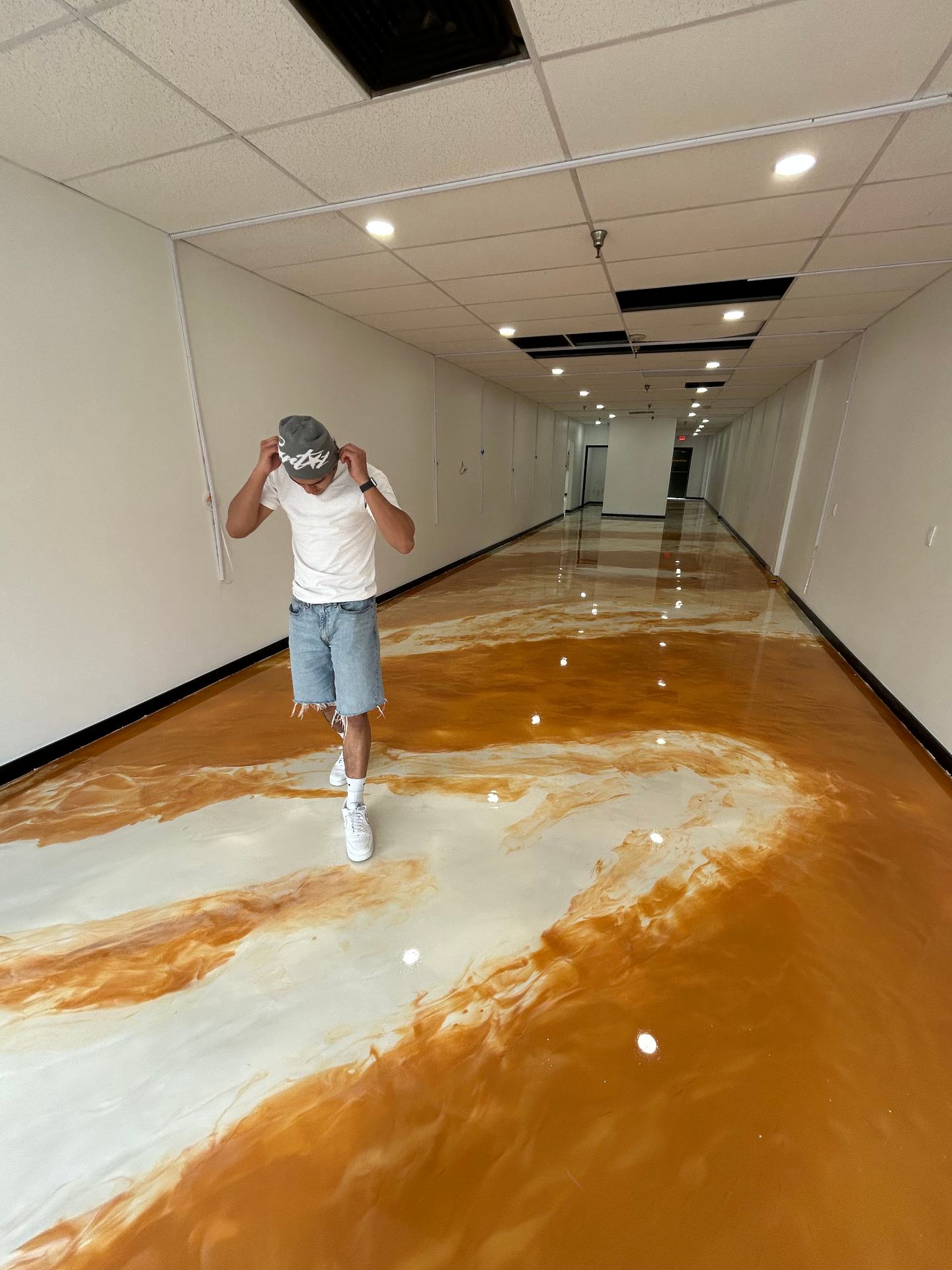
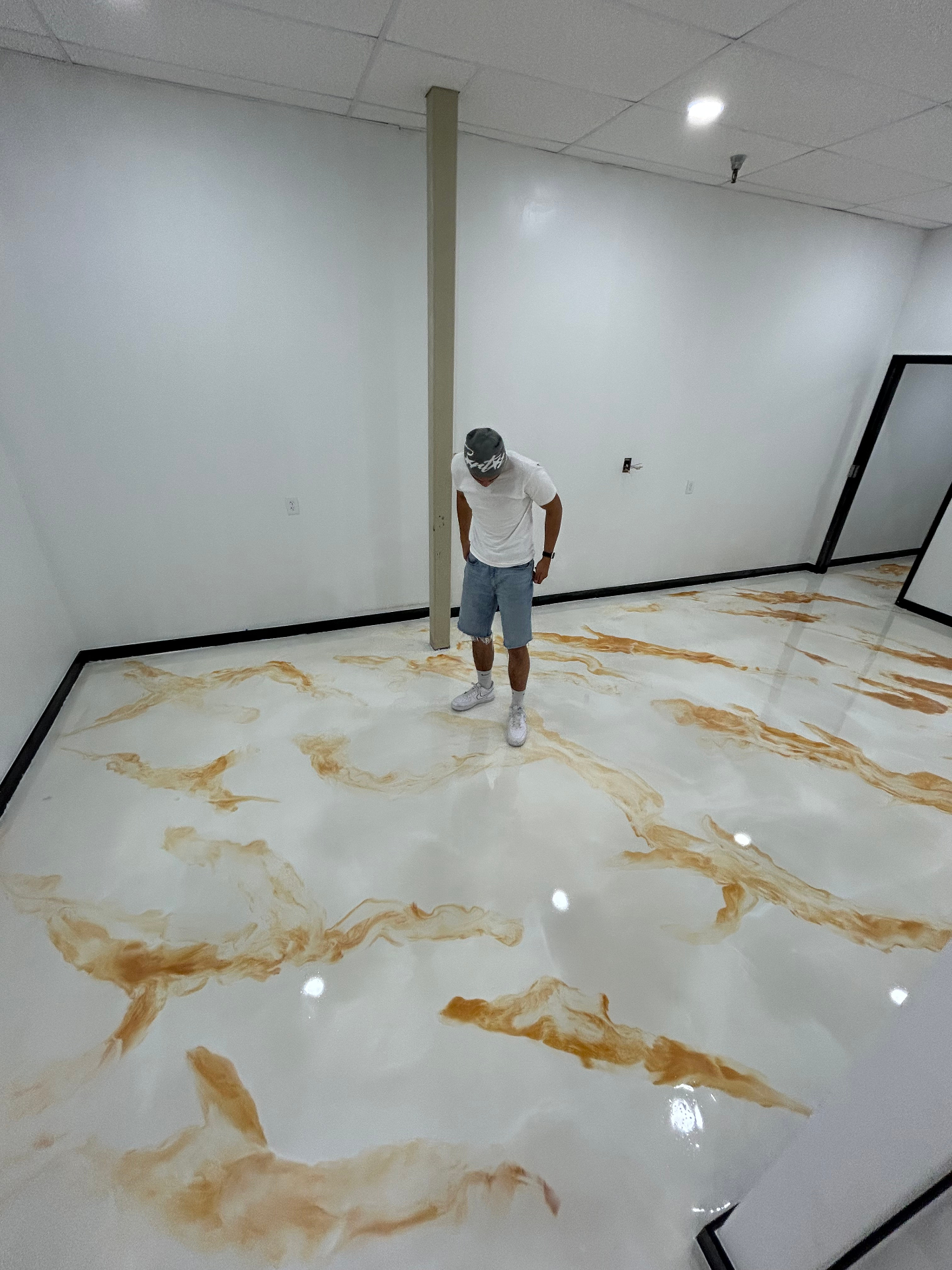
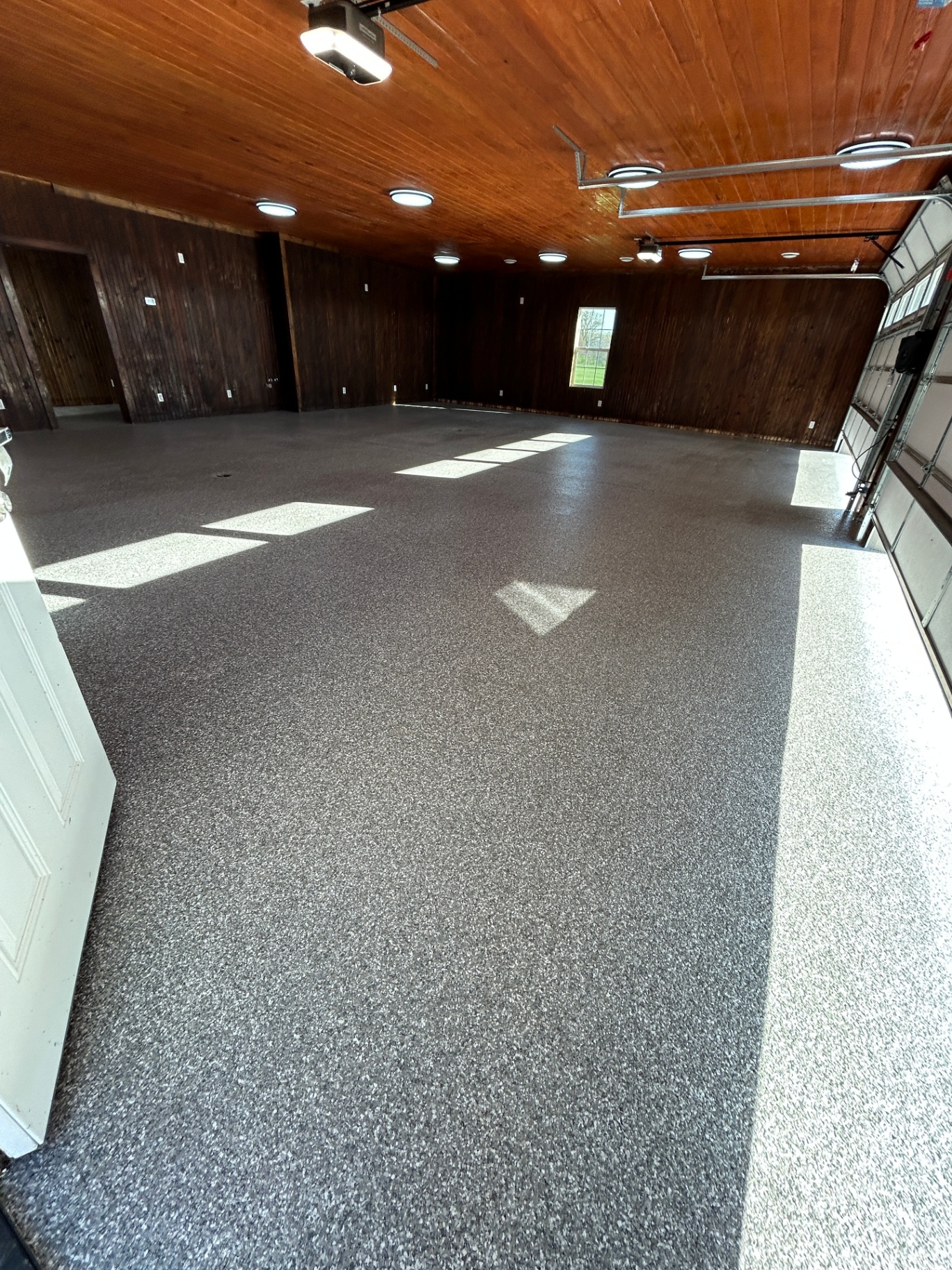
Real Northwest Arkansas metallic floors.
5.0 stars across Northwest Arkansas.
"We wanted the look of white marble in our entry and great room without the seams. Imperial poured a pearl-and-gold metallic that stops every guest at the door. Two years in it still looks like glass."
"Color, bleach, and acetone hit this floor every single day and it wipes clean every time. Clients constantly ask who did it. Best money we've spent on the studio."
"Our foyer went from tired tile to a floor the whole congregation talks about. The crew worked around our service schedule and left the building spotless."
The easiest floor in the building to take care of.
Daily cleaning is a dust mop, soft broom, or vacuum for dry debris. For anything sticky, damp mop with warm water and a pH-neutral cleaner. That is it — no wax, no polish, no annual sealing, no grout scrubbing, no steam cleaning. Avoid vinegar, citrus, and ammonia-based products; over time acidic and alkaline cleaners dull the gloss on any clear coat.
Protecting the gloss is mostly about grit control. Place walk-off mats at exterior doors, put felt pads under furniture legs and salon chairs, and sweep sand or gravel rather than dragging it underfoot. In garages, avoid parking on the floor with hot tires directly after long summer drives for the first week of cure.
Expected lifespan is 15 to 25+ years in a residential interior and 10 to 20 years under commercial traffic. Because the wear surface is the clear topcoat rather than the artwork, a floor that has taken a decade of abuse can be lightly abraded and re-topcoated — restoring full gloss without ever disturbing the metallic layer beneath.
Cure time matters early on. Light foot traffic is safe at 12 to 24 hours, furniture at 48 hours, vehicles and heavy rolling loads at 72 hours, and full chemical cure completes around day seven. Following that schedule is the single easiest thing you can do to guarantee a twenty-year floor.
The $300 kit costs more than the professional floor.
A big-box metallic kit contains thin water-based or low-solids epoxy, a packet of pigment, a stir stick, and an acid-etch pouch. There is no diamond grinding, no crack repair, no moisture testing, no 100%-solids resin, and no UV-stable topcoat. Every one of those omissions is a failure point, and they compound.
What actually happens: the acid etch fails to remove old sealer or glue, so the coating never bonds. Moisture in the slab pushes vapor upward and blisters the film. The thin resin gels too fast for the pigment to develop, so the pattern looks muddy and stops short of the walls. The non-UV clear coat ambers within two summers. And in a garage, hot tires lift the coating off the slab in sheets.
The expensive part is the recovery. A failed coating must be fully ground off before a professional system can be installed, which adds grinding hours, disposal, and additional prep to the real project. Homeowners across Northwest Arkansas routinely pay more to fix a kit floor than they would have paid to have it done correctly the first time. Preparation is not the boring part of the job — it is the job.
Metallic epoxy floors installed across NWA.
Locally owned and based in Northwest Arkansas — with statewide Arkansas service and travel into Missouri and Oklahoma for larger metallic projects.
Design your one-of-one metallic floor.
We'll visit your home or business anywhere in Northwest Arkansas, evaluate the slab, take moisture readings, walk through pigment options, and deliver a written estimate — free, on site, with zero pressure.
Everything homeowners and designers ask.
What is metallic epoxy flooring?
Metallic epoxy flooring is a 100%-solids epoxy resin system infused with micaceous metallic pigments. Once poured over a diamond-ground concrete slab, the pigments suspend and drift inside the wet resin, creating three-dimensional depth, marbling, and light movement that looks like polished stone, molten metal, or flowing water frozen in place. A clear UV-stable polyaspartic topcoat locks the artwork in and provides the wear surface.
How do the metallic pigments actually move?
The pigment particles are lighter than the resin and reflect light at different angles. As the epoxy self-levels, the installer uses air movement (leaf blowers, torches, and air guns), spreading tools, rollers, and controlled solvent drops to push pigment through the resin. Heavier base pigments settle while lighter accent pigments rise, forming veins, cells, and lensing. The floor keeps evolving for roughly 30 to 60 minutes after the pour until the resin gels.
Why is every metallic epoxy floor unique?
Because the pattern is created by fluid dynamics, not a printed or stamped pattern. Temperature, humidity, slab porosity, pigment ratio, pour thickness, and the installer's hand all change the outcome. Two floors poured from the same buckets on the same day will never look identical. Your floor is genuinely one of one — that is exactly why homeowners and designers choose it.
Can I choose my colors?
Yes. We build custom color pours from a full pigment library — pearl white and champagne gold, black and silver, copper and bronze, ocean blues and teals, emerald, charcoal, terracotta, and multi-tone blends. Bring us a paint chip, a countertop sample, a cabinet door, or a Pinterest board and we will formulate to match. We can also prepare a sample board before the pour.
Can I see a sample before you install?
Absolutely. For most residential and commercial metallic projects we prepare a physical sample board using your exact pigment blend so you can view it under your own lighting before we grind a single square foot.
How glossy is a metallic epoxy floor?
Our standard finish is a high-gloss, near-mirror polyaspartic topcoat that reflects light and furniture like polished stone. If you prefer something softer we also offer satin and matte topcoats, which reduce glare and hide dust while keeping the pigment depth intact.
Is metallic epoxy slippery?
High-gloss epoxy is comparable to polished tile when wet. For garages, restaurants, salons, entryways, and any space with water exposure we broadcast a fine anti-slip aggregate — aluminum oxide or polymer grit — into the topcoat. It is invisible in the finish but dramatically raises the coefficient of friction.
Why is diamond grinding required before a metallic pour?
Epoxy bonds mechanically, not chemically, to concrete. Industrial planetary diamond grinders remove existing sealers, paint, glue, laitance, and contaminants and open the slab to a CSP-1 to CSP-2 profile. That profile is what the primer grips. Skipping this step is the single most common cause of a metallic floor peeling or bubbling within a year.
Why not acid etching instead of grinding?
Acid etching is a chemical wash that cannot remove old coatings, oil, or glue, produces an inconsistent profile, leaves residual salts behind, and requires neutralizing and rinsing that reintroduces moisture into the slab. Every professional coating manufacturer and ICRI specify mechanical preparation. We diamond grind with HEPA dust extraction on every single project — no exceptions.
What happens to cracks and chips in my concrete?
Before priming, every crack, control joint, spall, and pop-out is chased open with a crack chaser, vacuumed, and filled with structural polyurea or epoxy mortar, then re-ground flush. This returns the slab to a monolithic surface so cracks do not telegraph through the finished metallic artwork.
What does the primer coat do?
The 100%-solids epoxy primer penetrates the freshly ground concrete, locks down remaining dust, seals the pores, and prevents outgassing bubbles from rising into the metallic layer. On slabs with elevated moisture readings we upgrade to a moisture-mitigation primer that blocks vapor transmission from below.
What is the topcoat and why does it matter?
The metallic layer is the art; the topcoat is the armor. We finish with a UV-stable polyaspartic or aliphatic urethane clear coat that provides abrasion resistance, chemical resistance, hot-tire resistance, and gloss retention. It also prevents ambering — the yellowing that happens when a cheap epoxy clear is exposed to sunlight.
Will my metallic floor turn yellow in sunlight?
Not with our system. Standard epoxy clear coats amber under UV exposure, which is why so many DIY metallic floors look dingy after two summers. Our polyaspartic topcoat is UV-stable and holds its color and clarity in sunrooms, showrooms, and glass-walled spaces.
Is metallic epoxy scratch resistant?
Yes. The polyaspartic topcoat is significantly harder and more abrasion resistant than epoxy alone. It handles foot traffic, pet nails, rolling chairs, salon carts, dropped tools, and vehicle traffic. Like any high-gloss surface, dragging unprotected metal furniture or grinding embedded grit underfoot can leave marks, so we recommend felt pads and walk-off mats at entries.
Is it chemical resistant?
Very. Our systems shrug off motor oil, brake fluid, gasoline, antifreeze, salt, hair color and bleach, acetone, wine, grease, food acids, and standard cleaning chemicals. Wipe spills up when convenient rather than immediately — the floor is non-porous, so nothing soaks in or stains.
How long does a metallic epoxy floor last?
A properly diamond-ground, primed, and polyaspartic-topcoated metallic floor lasts 15 to 25+ years in a residential interior and 10 to 20 years in commercial traffic. The finish can also be re-topcoated later without redoing the artwork, which effectively resets the wear surface.
How do I clean and maintain it?
Dust mop or vacuum for dry debris and damp mop with warm water and a pH-neutral cleaner. No wax, no polish, no sealing, no grout scrubbing. Avoid vinegar, citrus, and ammonia-based cleaners, which dull gloss over time. That is the entire maintenance program.
How long does installation take?
Most residential metallic projects take three to four days on site: day one grind, repair, and prime; day two metallic pour; day three topcoat; day four cure. Larger commercial floors are phased. We give you an exact schedule with your written estimate.
When can I walk on it and move furniture back?
Light foot traffic is typically fine 12 to 24 hours after the final topcoat. Furniture can return in about 48 hours, and vehicles or heavy rolling loads after 72 hours. Full chemical cure completes in roughly seven days.
How much does metallic epoxy flooring cost?
Metallic epoxy typically runs $8 to $16 per square foot installed, depending on slab condition, crack repair, moisture mitigation, pigment complexity, and topcoat selection. Multi-color and custom-designer pours sit at the higher end. Every estimate is free, on site, and delivered in writing with no pressure.
Can metallic epoxy be installed over tile, wood, or existing coatings?
It is installed over concrete. Tile, vinyl, glue, carpet tack strips, and old coatings are removed and the slab is ground clean first. If your space has a wood subfloor, metallic epoxy is not the right system and we will tell you that honestly rather than sell you a floor that will fail.
Can it go over radiant-heated concrete?
Yes. Metallic epoxy performs well over in-floor radiant heat. We simply coordinate the system temperature during installation and cure so the resin flows and gels correctly.
Does metallic epoxy work in basements?
It is one of the best basement floors available — seamless, waterproof on the surface, mold-resistant, and warmer underfoot than tile. Basement slabs almost always require moisture testing, and we install a vapor-blocking primer when readings call for it.
Why do DIY metallic epoxy kits fail?
Big-box kits are thin water-based epoxy with a packet of glitter and an acid-etch pouch. There is no diamond grinding, no crack repair, no moisture mitigation, no 100%-solids resin, and no UV-stable topcoat. They peel at the tires, bubble over damp slabs, yellow in sunlight, and typically fail inside 12 to 24 months — after which the failed coating must be ground off before a real floor can be installed.
Can you repair a metallic floor if it gets damaged?
Yes. Because we hold your pigment formula on file, isolated damage can be feathered, re-blended, and re-topcoated. Whole-floor refresh is also possible by lightly abrading the surface and applying a new clear topcoat.
Can you add logos, borders, or design elements?
Yes. Company logos, family crests, monograms, inlaid borders, color blocking, and coved edges can all be built into a metallic system for showrooms, offices, churches, and retail spaces.
What areas of Northwest Arkansas do you serve?
We install metallic epoxy floors in Springdale, Fayetteville, Rogers, Bentonville, Bella Vista, Lowell, Pea Ridge, Centerton, Cave Springs, Farmington, Prairie Grove, Siloam Springs, Elkins, Johnson, and throughout Northwest Arkansas — plus statewide Arkansas and nearby Missouri and Oklahoma for larger projects.
Are you licensed, insured, and certified?
Yes. Imperial Epoxy Flooring LLC is fully licensed and insured, and we are certified by XPS Xtreme Polishing Systems, an international training authority in advanced concrete polishing, surface preparation, and decorative coating systems.
Full-service coatings for every surface.
Garage Epoxy Flooring
Diamond-ground, polyaspartic-topcoated residential garage systems that last 20+ years.
Commercial Epoxy Flooring
Forklift-rated industrial systems for warehouses, plants, restaurants, and retail.
Full Flake Epoxy Systems
The industry standard for garages, shops, warehouses, and commercial spaces.
Quartz Flooring Systems
Heavy-duty decorative quartz for kitchens, medical, industrial, and food-service.
Grind & Seal Concrete
Modern industrial polished-concrete look with dust reduction for warehouses and retail.
Concrete Repair & Crack Chasing
Structural crack repair, spall repair, and joint filling for slabs of any size.